
/
/
Inside the PADI IDC: What Candidates Actually Do Each Day
Instructor Development
Inside the PADI IDC: What Candidates Actually Do Each Day
5 Sept 2024 · ⏱ 5 min read
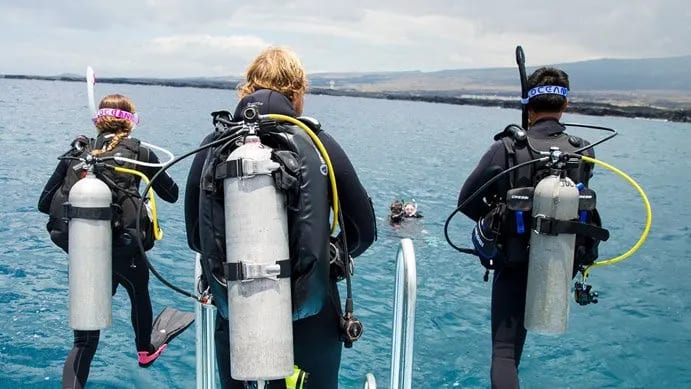
Ask ten Divemasters what an Instructor Development Course actually involves and you'll get ten different answers, most of them wrong. Some picture two weeks of gruelling swim tests. Others imagine sitting through PowerPoint slides until their eyes glaze over. Neither is close. An IDC is built around one repeated cycle: you prepare a presentation, you deliver it, you get evaluated, and you do it again slightly better. That cycle, repeated dozens of times across knowledge development, confined water, and open water, is what actually turns a strong diver into a competent teacher.
The morning: knowledge development
Most days start in the classroom, but not in the way people expect. You are not being taught to dive better; you already know how to dive. You are being taught how to explain diving to someone who has never done it, using PADI's Guided Discovery method rather than a straight lecture. A typical morning has two or three candidates each running a twenty-five to thirty-minute segment of a real Discover Scuba Diving or Open Water Diver knowledge review, complete with open questions, visual aids, and the kind of pacing that keeps a nervous student engaged instead of overwhelmed. The Course Director and any supporting IDC Staff Instructor score each presentation against PADI's standards and, more usefully, tell you exactly where you lost the room.
Confined water: teaching skills, not performing them
After lunch the group usually moves to confined water, and this is where most candidates get their first real shock. You already know how to clear a mask or recover a regulator. What you don't yet know is how to demonstrate it slowly enough, from the right angle, with the right hand signals, that a task-loaded first-time diver can copy you under water where you cannot simply talk them through it. Candidates take turns running full skill circuits for their peers acting as students, briefing on the surface, demonstrating underwater, and debriefing afterwards. It is physically unglamorous and mentally exhausting, and it is also the single most useful rehearsal you will do before standing in front of paying students for real.
Open water: everything at once
Open water presentations pull knowledge development, demonstration, and problem management together in real conditions, often in the sheltered bays around Golfo Aranci where visibility and easy entries let candidates focus on teaching rather than fighting the environment. You brief a dive, manage buoyancy while watching four "students" instead of one, deal with a simulated problem your Course Director throws in without warning, and then debrief honestly on the boat. This is also where candidates start to understand risk management from the instructor's seat rather than the diver's, which is exactly the mindset the rest of a PADI teaching career depends on.
Evenings: the part nobody warns you about
The teaching sessions end mid-afternoon, but the day doesn't. Evenings are for reviewing PADI Standards, working through the Instructor Manual, and preparing tomorrow's presentation, because you cannot teach what you don't understand precisely. Course Directors typically use this time for exam preparation and for one-on-one feedback that is far more direct than anything given in front of the group. Candidates who treat these hours as optional tend to be the ones who struggle on the IE.
Why the structure matters
None of this is arbitrary. Every presentation type maps directly to a skill you will use in your first week as a working instructor: explaining a concept clearly, demonstrating a skill so it can be copied, and managing a real dive with real risk. Candidates who understand that the IDC is rehearsal for the job, not an obstacle before it, tend to arrive at the Instructor Examination calmer and leave it as noticeably better teachers, not just certified ones.
If you're weighing up when to start, browse our upcoming IDC dates in Golfo Aranci, or get in touch through our contact page if you want a candid conversation about whether you're ready.
Ready To Take The Next Step?
Explore the IDC and Specialty Instructor courses, meet the team, and start your instructor journey with IDC Sardegna.
More From IDC Sardegna
 Career DevelopmentBuilding a PADI Professional Portfolio That Gets You HiredWhat dive centres actually look for beyond a certification card, and how to build a professional portfolio that makes hiring you an easy decision.5 Aug 2026 · 4 min read
 Specialty TrainingTeaching the Underwater Naturalist Specialty with PurposeHow to move Underwater Naturalist beyond a fish-identification checklist into a course that genuinely changes how students dive and observe.5 Jul 2026 · 4 min read
 Professional DevelopmentThe Mermaid Instructor Course: Widening Your Teaching RangeHow the Mermaid Instructor pathway broadens an instructor's skill set and business, and why it draws on real diving competence, not novelty.5 Jun 2026 · 4 min read
 Chat with us