
/
/
Why Every Dive Centre Needs Trained Emergency Oxygen Providers
Safety
Why Every Dive Centre Needs Trained Emergency Oxygen Providers
5 Feb 2026 · ⏱ 4 min read
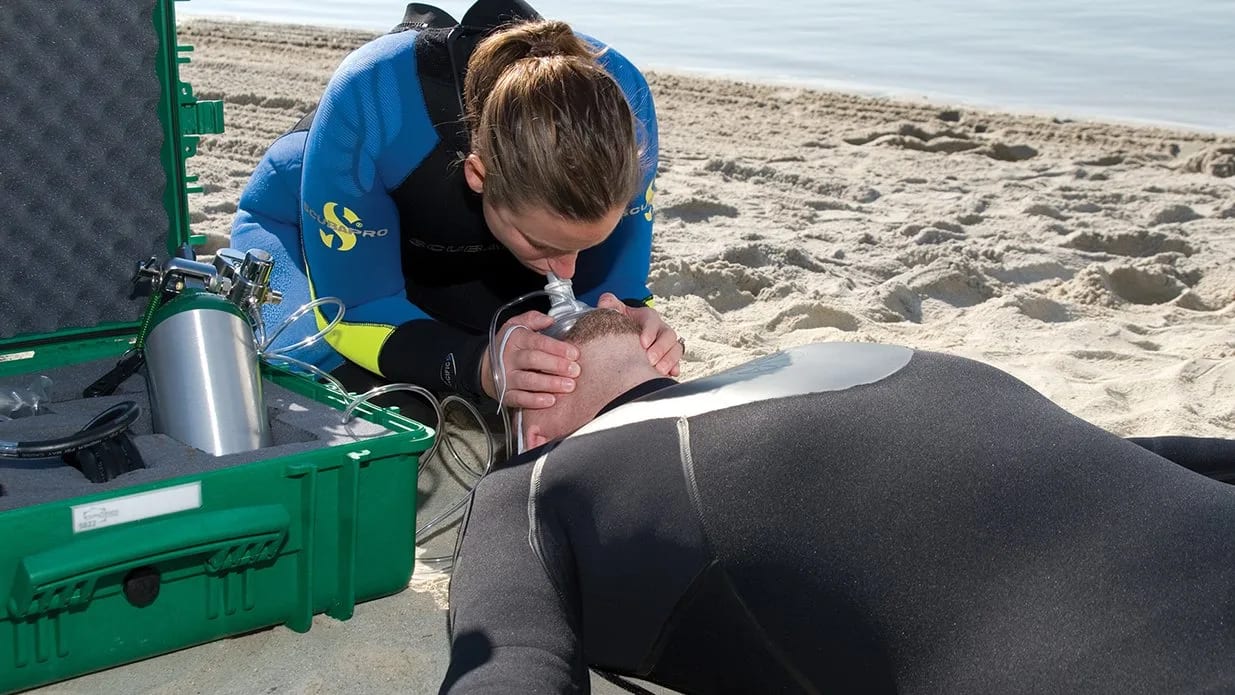
Every dive centre owner will tell you they take emergency preparedness seriously, and most genuinely believe it. Then ask a more specific question: on any given operating day, exactly how many people on site are current and confident in emergency oxygen administration, and where physically is the oxygen unit relative to where a diving incident is most likely to actually happen? The answers are often vaguer than the centre's confidence would suggest.
The gap between owning oxygen and being ready to use it
Nearly every dive centre owns an oxygen unit. Far fewer can say, without checking, that every staff member on the boat today is trained, current, and comfortable administering it under real pressure rather than in a calm training scenario. Certification lapses quietly; confidence with unfamiliar equipment fades faster than people expect if it isn't practised. The gap between owning the equipment and being genuinely ready to use it is exactly where risk hides.
Emergency Oxygen Provider versus Advanced Oxygen Provider
PADI offers two relevant ratings here, and understanding the difference matters for staffing decisions. Emergency Oxygen Provider covers the core skill: recognising a diving injury that may benefit from oxygen and administering it correctly to a breathing patient. Advanced Oxygen Provider extends that into non-breathing emergencies and multiple delivery methods, which matters because a real incident doesn't announce in advance which scenario you'll be facing. A centre relying entirely on basic-level coverage is betting that every future incident will be the simpler kind.
Redundancy is the actual safety measure
The instinct to designate one senior staff member as "the oxygen person" feels efficient and is actually a significant risk concentration. That person might be on a different boat, might be the one who's injured, or might simply be busy managing the incident itself and unable to also run oxygen delivery alone. Real emergency readiness means multiple staff, across every operating day and every boat, independently capable and current, not a single point of coverage that looks adequate on paper.
Equipment placement and drills, not just certification
Certification solves the knowledge problem but not the logistics problem. Oxygen units need to be positioned where they're genuinely fast to reach from wherever incidents actually happen on your specific boats and sites, not wherever was convenient to store them. Running an unannounced drill occasionally, timing how long it actually takes from "diver reports symptoms" to "oxygen flowing," reveals gaps that a certification card alone never will.
Building this into your team, not just your equipment list
Centres serious about closing this gap should think about oxygen provider training the same way they think about EFR coverage: as a staffing requirement, not an optional extra a few enthusiastic staff happen to hold. Combined with a broader EFR Instructor presence on the team, comprehensive oxygen provider coverage turns "we have a unit somewhere" into a genuine, tested safety system.
Making it a standing priority
This isn't a one-time fix. Staff turnover, certification lapses, and simple complacency erode oxygen readiness quietly over time unless a centre revisits it deliberately, ideally as part of the pre-season preparation we've written about before. It's a small, unglamorous investment relative to the actual risk it addresses.
If you'd like to build out proper emergency oxygen coverage across your team, get in touch through our contact page.
Ready To Take The Next Step?
Explore the IDC and Specialty Instructor courses, meet the team, and start your instructor journey with IDC Sardegna.
More From IDC Sardegna
 Career DevelopmentBuilding a PADI Professional Portfolio That Gets You HiredWhat dive centres actually look for beyond a certification card, and how to build a professional portfolio that makes hiring you an easy decision.5 Aug 2026 · 4 min read
 Specialty TrainingTeaching the Underwater Naturalist Specialty with PurposeHow to move Underwater Naturalist beyond a fish-identification checklist into a course that genuinely changes how students dive and observe.5 Jul 2026 · 4 min read
 Professional DevelopmentThe Mermaid Instructor Course: Widening Your Teaching RangeHow the Mermaid Instructor pathway broadens an instructor's skill set and business, and why it draws on real diving competence, not novelty.5 Jun 2026 · 4 min read
 Chat with us