
/
/
Demonstrating Skills So Students Can Actually Follow Them
Teaching Techniques
Demonstrating Skills So Students Can Actually Follow Them
5 Jan 2025 · ⏱ 4 min read
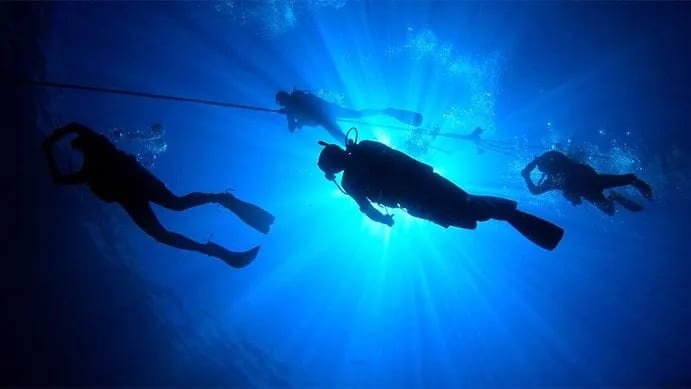
Watch enough confined water sessions and a pattern emerges: instructors who are excellent divers often give unremarkable demonstrations, while instructors with fairly average diving skills sometimes teach beautifully. The difference has almost nothing to do with how well the instructor performs the skill and almost everything to do with whether the demonstration was built to be copied by someone who has never done it before.
The demonstration is not for you
It's an easy trap: after hundreds of repetitions, mask clearing or regulator recovery becomes so automatic that instructors demonstrate it at their own comfortable, practised speed. A first-time student watching that demonstration isn't seeing a sequence of steps, they're seeing a blur. Slowing a demonstration down to roughly half your natural pace, with a distinct pause between each component step, gives the student's brain time to actually register what happened rather than just watching it happen.
Positioning is half the job
A perfectly paced demonstration still fails if the student can't see it properly. Facing students directly, at their eye level, with hands kept clear of your body rather than tucked against your chest, sounds obvious written down and is routinely ignored in practice, especially by instructors who learned to dive facing a wall or a reef rather than facing people. Before every confined water session, it's worth physically checking your position from where the student will be kneeling or hovering, not just from where you naturally settle.
Sequencing: break it, then rebuild it
Complex skills benefit from being taught in visibly separate chunks before being shown as one fluid sequence. Regulator recovery, for instance, teaches better as three distinct demonstrations, the sweep, the purge, the return to normal breathing, before you ever show it as a single smooth motion. Students who only ever see the fluid version tend to blend the steps together incorrectly under water, because they never separately encoded each part.
Use hand signals as part of the demonstration, not an afterthought
A demonstration that includes clear "watch me," "your turn," and "okay?" signals at the right moments teaches the surrounding communication skills at the same time as the physical skill. This matters more than it might seem: a student who can perform a skill perfectly but can't confirm understanding or signal a problem afterward hasn't actually learned to dive safely, they've learned to mimic a motion.
A quick self-check for your next session
- Am I demonstrating at half my natural speed, with visible pauses between steps?
- Can every student see my hands and face without repositioning themselves?
- Have I broken a multi-step skill into separate demonstrations before showing it as one motion?
- Did I use the same hand signals I'll expect the student to use back to me?
Where this compounds
Instructors preparing for their IDC spend real time on exactly this skill, because confined water presentations are evaluated on clarity, not just correctness. It's also a skill that pays off well beyond entry-level courses: teaching a Dry Suit Diver student to manage inflator control, or a Underwater Navigator student to hold a compass heading, depends on exactly the same demonstration discipline, just applied to more complex movements.
If you're building or refining your own teaching style ahead of instructor training, our specialty instructor courses page is a good place to see how these techniques scale across different skill types.
Ready To Take The Next Step?
Explore the IDC and Specialty Instructor courses, meet the team, and start your instructor journey with IDC Sardegna.
More From IDC Sardegna
 Career DevelopmentBuilding a PADI Professional Portfolio That Gets You HiredWhat dive centres actually look for beyond a certification card, and how to build a professional portfolio that makes hiring you an easy decision.5 Aug 2026 · 4 min read
 Specialty TrainingTeaching the Underwater Naturalist Specialty with PurposeHow to move Underwater Naturalist beyond a fish-identification checklist into a course that genuinely changes how students dive and observe.5 Jul 2026 · 4 min read
 Professional DevelopmentThe Mermaid Instructor Course: Widening Your Teaching RangeHow the Mermaid Instructor pathway broadens an instructor's skill set and business, and why it draws on real diving competence, not novelty.5 Jun 2026 · 4 min read
 Chat with us